Every April, the world pauses for a day to think about the planet. Earth Day comes round with its hashtags, clean-up drives, documentaries, and sobering statistics, and then it passes again. There is something quietly revealing in that. One day out of three hundred and sixty-five. One brief moment to pay attention to what should really have been the settled instinct of every generation.
The very existence of Earth Day tells us something uncomfortable: our relationship with this world is no longer what it should be. Something has been damaged. Something has been forgotten.
But the Bible begins from a very different place.
In Scripture, the world is never just a resource, and it is never really ours. “The earth is the LORD’s, and the fulness thereof; the world, and they that dwell therein” (Psalm 24:1). That settles the question of ownership before any discussion of stewardship even begins. The mountains are His. The oceans are His. Every creature in the forest and every living thing in the sea belongs to Him. And when God finished His creative work, Genesis tells us that He saw it all and called it very good.
The world was not made broken. It was made beautiful.
The damage came early. By the third chapter of Genesis, the ground is cursed because of Adam’s disobedience. By chapter four, Abel’s blood cries out from that same ground, and Cain is told it will no longer yield its strength to him. By chapter six, we read one of the saddest lines in Scripture: “the earth also was corrupt before God, and the earth was filled with violence” (Genesis 6:11).
It happens with shocking speed. Creation is only a few chapters old, and already it is bearing the weight of human sin. The pattern is there almost at once: where mankind goes, the ground pays the price.
That has not really changed. Paul writes that “the whole creation groaneth and travaileth in pain together until now” (Romans 8:22). Creation, in his words, is not just damaged in practical ways. It is caught up in the tragedy of human failure. It suffers because we suffer. It waits because we wait.
And that brings us to our place in it now. Dominion in Genesis 1 was never permission to plunder. It sits alongside the instruction in Genesis 2 to “dress it and keep it” — to cultivate and to guard. That is the original calling. Not to exploit, but to tend. Not simply to take, but to care.
If the earth belongs to God, then how we treat it is not just an environmental issue. It is a question of reverence. A Christian does not need a climate summit to recognise that waste, cruelty, and needless destruction are offences against the Creator. We do not worship creation, but we should treat it with honour, because it bears the touch of His hands.
Still, we have to be honest. Stewardship matters, but it cannot by itself heal what sin has done. The groaning Paul describes will not finally be silenced by recycling schemes or renewable technologies, valuable though such things may be. Something deeper is needed. And this is where Scripture lifts our eyes.
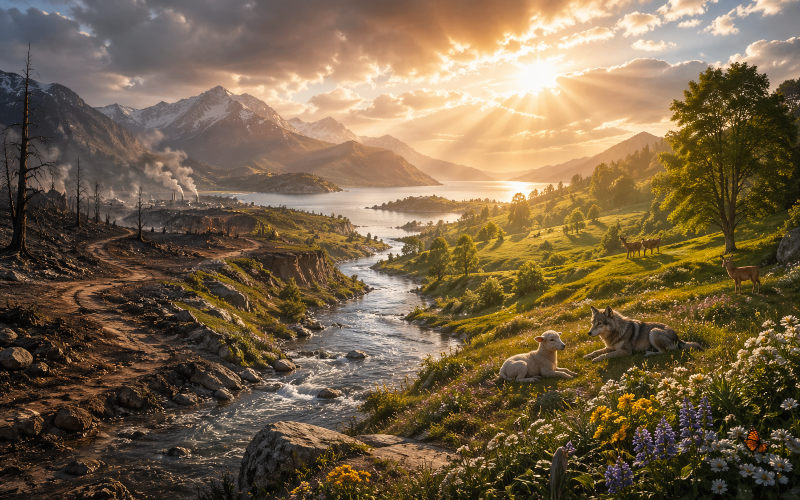
The prophets never saw the world as something to be discarded. They saw it as something waiting to be restored. Isaiah describes a day when “the wolf also shall dwell with the lamb,” and when “they shall not hurt nor destroy in all my holy mountain” (Isaiah 11:6, 9). Habakkuk speaks of the time when “the earth shall be filled with the knowledge of the glory of the LORD, as the waters cover the sea” (Habakkuk 2:14). And in Numbers, God Himself declares, “as truly as I live, all the earth shall be filled with the glory of the LORD” (Numbers 14:21).
These are not vague words about escaping to somewhere else. They are promises about this world — these hills, these rivers, this soil.
Revelation draws the line clearly. There will come a day when God will “destroy them which destroy the earth” (Revelation 11:18). This world is not going to be abandoned. It will be cleansed, renewed, and filled with the glory God intended from the beginning.
So for those who know the Scriptures, Earth Day becomes more than a yearly environmental observance. It is a quiet reminder of what was lost in Eden, of what creation still carries now, and of what will one day be restored when Christ returns.