Who Are the Christadelphians?
Most people haven't heard of them. That's not entirely surprising. Christadelphians don't have a media presence, they don't run large campaigns, and they don't tend to appear in the kinds of religious debates that make the news. But they've been around since the mid-1800s, they're spread across dozens of countries, and they hold a set of beliefs that, once you start looking at them, turn out to be surprisingly well thought through.
So who are they, and what do they actually believe?
The name
The word "Christadelphian" comes from two Greek words: Christos and Adelphoi, which together mean something like "brethren in Christ." It was adopted during the American Civil War, partly for practical reasons, as a way of identifying themselves as a distinct religious group. But the name also captures something about how they see themselves. Not as a church with a hierarchy or a headquarters, but as a community of people trying to follow Christ together. There's no central authority, no paid clergy, no official spokesperson. Local congregations, which they call "ecclesias," operate independently, and the whole thing runs on voluntary effort.
It's a quieter model of religious life than most people are used to.
The Bible at the centre
If there's one thing that defines Christadelphians, it's probably their relationship with the Bible. They treat it as God's inspired word, and they mean that quite seriously. Not as a loose collection of spiritual ideas to dip into when the mood strikes, but as a coherent message that holds together from Genesis to Revelation, and that provides everything a person needs to understand God's purpose with the world.
That commitment shows up in practice. Bible reading is daily, structured, and lifelong. Most Christadelphians follow a reading plan that takes them through the Old Testament once and the New Testament twice every year, which means they're constantly encountering the full breadth of Scripture rather than just the familiar passages. There's a culture of personal study that runs deep, and the expectation is that you engage with the text yourself rather than relying on someone else to interpret it for you.
It gives the community a certain character. Conversations tend to come back to Scripture quite naturally, not in a performative way, but because the Bible genuinely functions as the reference point for how they think about things.
What they believe about Jesus
Christadelphians believe that Jesus is the Son of God, born of the virgin Mary, and that he lived a sinless life in perfect obedience to his Father. They see his death on the cross as a sacrifice for sin, and his resurrection on the third day as the foundation of the hope they hold. So far, that's recognisable Christian ground.
Where they sit slightly differently is on the question of Jesus's nature. They don't hold to the doctrine of the Trinity. In their understanding, Jesus is not God the Son in the Nicene sense, but the Son of God, a human being uniquely brought into existence by God's power, who overcame sin in his own nature and was raised and glorified as a result. It's a distinction that matters to them, not because they want to diminish Jesus, but because they think it makes the achievement of his life more remarkable, not less. A sinless life lived in real human nature, with real human temptation, carries a different weight than one lived by someone for whom failure was never a genuine possibility.
You don't have to agree with that reading to see the logic in it.
Salvation and the Kingdom
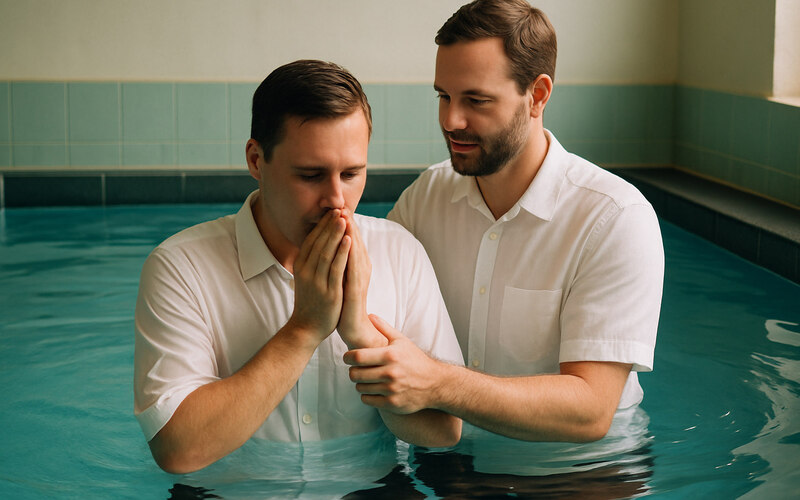
Christadelphians believe that salvation is a gift from God, offered through faith in Jesus Christ, and that it's open to anyone willing to learn, believe, and respond. That response takes a specific form: baptism by full immersion, undertaken as an adult, after a person has come to understand the gospel message for themselves. It's not something done to infants or treated as a cultural formality. It's a conscious, personal decision.
What they're looking forward to is also quite specific. They believe Jesus will return to the earth, literally and physically, to establish the Kingdom of God. Not a spiritual kingdom in people's hearts, and not heaven in the traditional sense, but an actual kingdom on this earth, with Christ reigning from Jerusalem, the dead raised to judgment, and the faithful given eternal life. It's a hope that shapes how they think about the future. The world isn't winding down towards destruction in their view. It's heading towards renewal.
There's something grounding about that kind of expectation. It keeps the focus on this world, this life, and what God intends to do with it.
The resurrection
Tied closely to all of this is their belief in resurrection. Christadelphians don't believe in an immortal soul that floats off somewhere at death. When a person dies, they're dead, conscious of nothing, waiting. The hope isn't in some immediate afterlife but in the resurrection at Christ's return, when the responsible dead will be raised, judged, and either granted eternal life or allowed to perish.
It's a view that takes death seriously. There's no comfortable workaround, no automatic passage to a better place. The entire weight of hope rests on what God has promised to do through Christ, and on the faithfulness of that promise. For Christadelphians, that makes the resurrection not just a doctrine but the doctrine, the one that everything else hangs on.
What you'd notice if you visited
If you walked into a Christadelphian meeting on a Sunday morning, you'd probably be struck by how simple it is. There's no band, no stage lighting, no polished production. The centre of the service is the breaking of bread, a shared remembrance of Christ's death, done weekly, and taken seriously. There'll be a Bible talk, usually given by one of the members rather than a professional minister, and there'll be readings and hymns. It's plain, and deliberately so.
You'd also notice that the community is close. These are people who know each other well, who study together, eat together, and look out for each other in practical ways. The lack of a paid clergy means that everyone contributes. Someone gives the talk, someone else prepares the readings, someone organises the Sunday school, someone makes the tea. It creates a kind of shared ownership that larger, more structured churches sometimes struggle to maintain.
A quieter kind of faith
Christadelphians aren't trying to be provocative or countercultural for the sake of it. They're simply trying to read the Bible carefully and live by what they find there. That leads them to some conclusions that sit outside the mainstream, and to a way of life that's more restrained than many modern expressions of Christianity. No political activism, no military service, no chasing after cultural relevance.
Whether that appeals to you probably depends on what you're looking for. But there's something worth respecting in a community that has held to the same core beliefs for over 170 years, not because of tradition or institutional momentum, but because they keep going back to the same book and finding the same things in it.
If nothing else, they're worth knowing about.